
Games and software at This is Vegas
 Available in GB
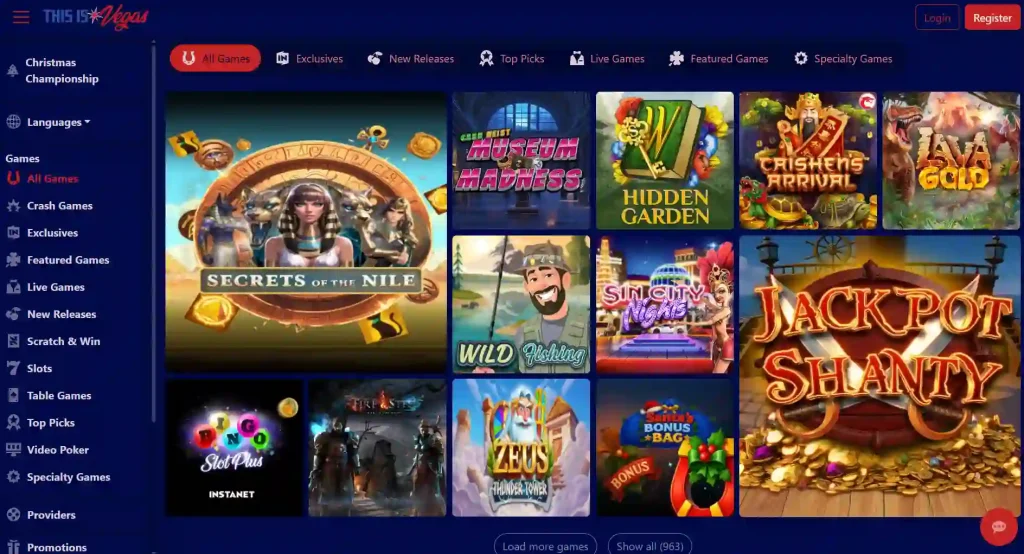
This is Vegas combines slots, live-dealer tables, digital table games and several shorter-form game categories in a multi-supplier lobby. Its game selection is more varied than a single slot list, but the most useful distinctions concern what each format does, who develops it and how the underlying rules affect the risk of repeated stakes. A catalogue count describes a selection of games, not a promise that every title will remain available.
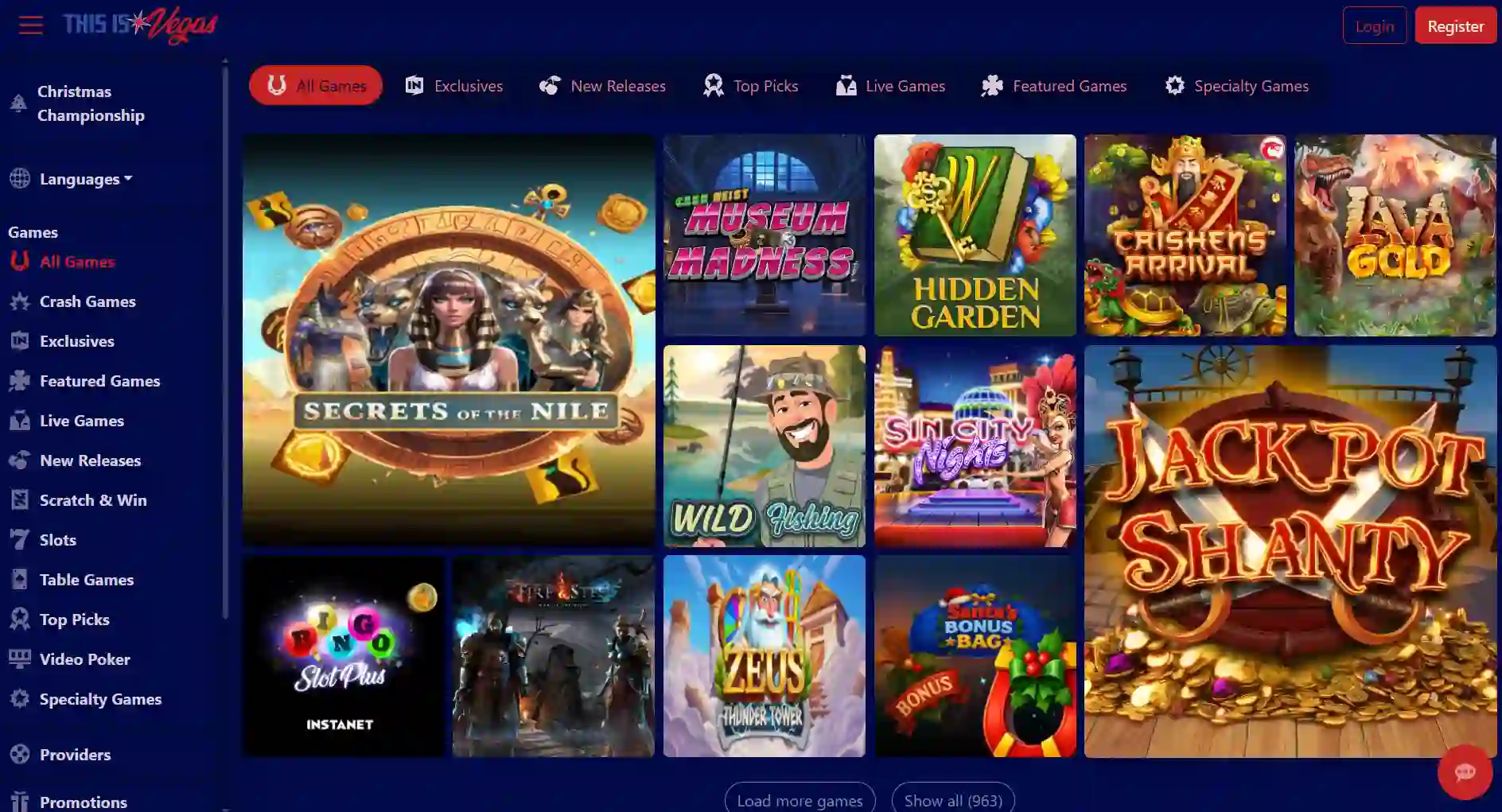
Table of Contents
Slots lead a catalogue that also includes live games
Slots anchor the This is Vegas lobby, but the wider catalogue also separates Live Games, Table Games, Video Poker, Crash Games, Scratch & Win and Specialty Games. That structure matters because a slot session, a live-dealer table and a video-poker hand involve different rules, decision points and session rhythms. A large headline catalogue cannot by itself explain how varied a particular type of play will feel.
The catalogue has displayed 978–980 games. That range describes its scale, not a permanent live count. A game library can change as titles are rotated, categories are reorganised or software arrangements change. The 978–980 figure helps convey the breadth of the lobby across more than one format.
One way to read the menu is by the activity each category represents. Slots generally centre on predefined paylines, symbols and feature rounds. Table Games usually group familiar rule-based formats. Video Poker draws on poker hand rankings but plays as a machine game. Crash Games involve timing or cash-out decisions against an escalating multiplier; the mechanics and risk are unlike a conventional spinning reel. Scratch & Win and Specialty Games add shorter or less familiar rule sets. These are descriptions of game formats, not promises about any individual title’s odds.
- Slots: Look at the paytable, stake increments and feature rules for the specific title; the appearance of a game is not a measure of its return.
- Table and video-poker games: Game variants can change the relevance of player decisions and the mathematical return of a particular set of rules.
- Crash and specialty titles: Rapid decision cycles can make the amount exposed during a session hard to judge without counting stakes.
- Live games: The room format introduces scheduled rounds or a dealer-led rhythm rather than a conventional slot animation.
The casino also uses an Exclusives label in its homepage carousel, which has been displayed with 82–84 entries. That is a lobby classification, not evidence that the casino built those games or that they offer independently checkable outcomes. A category badge tells a visitor where a game sits in the catalogue; the supplier and the rules explain more about the product itself.
For a closer look at how promotional turnover may depend on eligible game activity, the bonus wagering mechanics are a separate question from the size of the games menu. The library describes selection; the applicable rules determine what particular play can count towards a promotional condition.
RNG testing and advertised payout rates mean different things
Most digital casino games use a random number generator, or RNG, to select outcomes under a programmed set of rules. The generator’s role is to produce unpredictable results according to a game’s design; it does not decide the advertised payout percentage. That percentage comes from the game’s mathematical model and the distribution of outcomes over a very large number of rounds.
The This is Vegas FAQ describes independent RNG testing for Rival games. Its Security material also makes an historical claim of an average payout rate “over 97%” across its games. Those are two different assertions by the casino: one concerns testing of a software component, while the other concerns an aggregate return measure. Neither should be converted into a measured return for every current title or a guarantee for any session.
Return to player (RTP) is a long-run theoretical proportion of stakes returned by a game model. It is not a refund rate for an individual player, and short sessions can finish far above or below it. The corresponding house edge describes the expected share of stakes retained by the game in the long run. For illustration only, a hypothetical game with a 96% theoretical RTP has a 4% house edge. That example is not a This is Vegas title or payout figure.
Volatility is different again. A game can have a relatively high theoretical RTP and still produce long stretches without meaningful wins, particularly if a large share of its overall return is concentrated in infrequent features. A game with more frequent small returns may feel steadier while still carrying a similar mathematical cost. Neither pattern turns a negative-expectation game into a savings product.
- Identify the particular game. A provider name or category is not a substitute for a title-specific rules screen.
- Read the paytable and feature rules. Understand what creates a winning outcome and whether stake size affects feature access.
- Separate theory from a session. RTP speaks to repeated play over a mathematical horizon; any one sequence can diverge sharply.
- Measure exposure in total stakes. Repeated small bets accumulate even if the on-screen balance temporarily rises.
The casino FAQ also describes free-money or play-for-fun game access, with some account flows involving registration. Such modes can help someone understand screen controls and the sequence of game actions. They should not be read as evidence that the same sequence of outcomes, balance movement or session experience will occur with real money.
An advertised average across many games has further limitations: it can obscure major differences between slots, table variants and live games, and it can change as the catalogue changes. The game title, its rules and its own return information are the meaningful unit of comparison, rather than a single banner figure spanning the lobby.
Rival and Betsoft sit among several suppliers
The range comes from a multi-provider catalogue rather than one studio’s portfolio. Rival and Betsoft appear alongside Saucify, SmartSoft Gaming, InstaNet, Wingo, Qora Games and Dragon Gaming in the casino’s game catalogue. An independent Casino Guru catalogue lists 14 providers, including other suppliers such as Spinomenal, Tom Horn, Fresh Deck Studios, Fugaso, Felix Gaming and Vivo Gaming. That inventory is a useful cross-section of the broader product, not an assertion that every supplier appears in every regional lobby.
Supplier diversity has practical consequences. Studios may use different reel layouts, bonus features, game engines, artwork and control conventions. A person moving between two slots may encounter a different meaning for a feature-buy control, an autoplay setting or a visible stake display. These are game-design variations, not indicators that one provider is necessarily safer or more favourable.
Several titles illustrate the mix: Gold Rush is associated with Rival in the catalogue, while Wilds of Fortune, Thai Blossoms and Stampede are listed as Betsoft titles. Naming these games describes catalogue examples; it does not establish current availability for an account in Great Britain. The individual title’s information screen remains the place where its mechanics become meaningful.
A provider logo can also have several interpretations. It might identify the game developer, a platform integration or a brand used on an older title. That distinction matters when interpreting the casino’s claim about Rival RNG testing. A statement about one supplier’s software cannot automatically be stretched to every independent engine represented in the current lobby.
| Catalogue area | Examples in the This is Vegas inventory | What to compare |
|---|---|---|
| Slot studios | Rival and Betsoft | Rules, stake choices and bonus-feature mechanics |
| Additional game providers | Saucify, SmartSoft Gaming, Wingo and Qora Games | Game format and the relevant title-level information |
| Live and table selection | Live Games and Table Games categories | Round format, rules and pace of decisions |
Counting provider names is only a starting point for describing variety. A site with many suppliers can still concentrate its visible menu in a small number of popular mechanics, whereas a smaller supplier pool can contain several genuinely distinct game formats. The clearest reading of This is Vegas is as a broad multi-studio lobby, with the specifics decided by the game selected rather than the publisher list.
The live section is smaller than the wider lobby
The This is Vegas homepage has displayed the label “View all 15 Live Games” for its live section. That label describes a particular catalogue count, not a permanent total. It nonetheless shows that live-dealer games form a more focused corner of a lobby otherwise dominated by multiple categories of digital games.
Independent catalogue descriptions include blackjack, roulette and baccarat among the wider table-game types associated with the casino. The distinction between a live variant and a computer-based table variant is important: the basic game may share a name, but its interface, time between rounds, available side bets and interaction with a dealer can differ. A title labelled blackjack is not enough to infer the specific rules or theoretical return.
A live table tends to impose the rhythm of dealing, betting windows and result announcements. A digital table game may allow a much faster sequence of decisions. Neither format removes the underlying risk; the difference is how visibly a session advances and how many decisions can fit into the same period. A slower pace can still involve large stakes, while rapid digital rounds can multiply modest stakes before the total is obvious.
Table-game decisions also require more care than a broad category menu suggests. Blackjack rule variations, roulette variants and additional side bets can change a game’s mathematics. The name of a game family does not settle those details. Casino games should be understood through their displayed rules, not through a general claim that all titles in a category behave alike.
This is Vegas can be browsed through a mobile browser on iOS and Android, an important practical characteristic of a varied catalogue. A compact screen can make it harder to see a whole rules panel, a game history and the available controls at once. The browser-based account access section explains the separate login, document and support considerations surrounding that mobile experience.
The distinctive feature of the This is Vegas catalogue is therefore breadth across suppliers and formats, not a universal payout expectation. The site combines slots, live tables, video poker and shorter-form games, while individual titles remain the right level for judging rules and mathematical risk.
Questions about This is Vegas games
What kinds of games does This is Vegas list?
This is Vegas lists slots, live games, table games, video poker, crash games, Scratch & Win and specialty games across its catalogue.
Which software providers appear at This is Vegas?
Rival, Betsoft, Saucify, SmartSoft Gaming, InstaNet, Wingo and Qora Games appear in the casino’s catalogue material, alongside other suppliers in independent game inventories.
Does the advertised payout percentage apply to every game?
No. The casino’s historical claim of an average payout rate over 97% is an aggregate marketing statement, not a measured RTP for each game or a guarantee of player results.
The clearest strength is range across several game formats
This is Vegas brings Rival and Betsoft titles together with other software studios, a large slot-oriented library and a smaller live-game section. The 978–980 game range illustrates the size of the catalogue without promising a fixed total; it does not replace title-level information. The useful comparison is between game rules, pacing, volatility and the way stakes accumulate across different formats.
The casino’s average-payout wording and supplier-testing statements describe different subjects. Neither converts a general catalogue impression into a prediction for an individual game. The practical value of the library lies in the choice of distinct formats; the financial risk stays attached to each individual decision and stake.